Task Trajectory: User Journeys for the AI-driven workplace

Employees don't think in terms of systems, pages, or organisational charts. They think in tasks: submit my expenses, find a policy, request equipment, book travel, get support.

But in today's digital workplace, these tasks sit across fractured processes, conflicting sources, ambiguous policies and multiple tools. Now Copilot and other AI systems are surfacing all of it, good and bad. When employees ask AI for help, they expose the hidden inconsistencies that were previously masked by human judgement and local knowledge.

We've created a detailed framework and process that systematically maps the employee journeys across your digital workplace. The result is a clear, evidence-based picture of the journeys your people actually take, the friction they encounter, and the danger zones where AI systems will generate misinformation if left unaddressed. Task Trajectory provides the insight you need to redesign journeys, strengthen provenance, increase clarity, and build an organisational environment where people (and AI) can give accurate, authoritative answers.

Understand users, gauge accuracy

Most digital workplaces still rely on assumptions instead of reflecting how work actually gets done. But AI changes the stakes. If employees struggle to find information, AI will struggle too, and any ambiguity or inconsistency will be amplified in the answers it produces. This introduces massive risks into the digital workplace, so understanding how a diverse workforce completes tasks and gets support across tools, countries and business units is now essential. These user journeys expose where tasks are blocked, where processes diverge, where content contradicts itself, and where AI will fail or provide misinformation. They also provide an essential starting point to get your stakeholders aligned about the best away forward.

This is what we do

We conduct deep, structured interviews with employees and stakeholders across multiple regions, roles and systems to understand how work actually happens. Using insights from dozens of digital workplace projects, we apply our proven Task Trajectory framework to map user journeys end-to-end, identify blockers, and reveal where content is likely to cause a misinformation risk. We surface the gaps that cause operational friction and the ambiguities that will cause AI tools like Copilot to produce unreliable answers. The result is a clear set of user journeys, risks, and opportunities that give you the evidence and direction to improve findability, streamline processes, reduce confusion, and prepare your digital workplace for safe and effective AI adoption.

How it works

Task Trajectory is a detailed task mapping and risk management methodology involving a kick-off workshop and discovery session, a set of user and stakeholder interviews, an analysis phase, a report with insights and recommendations, a set of detailed user journey charts with rich insights and strong process visualisations and a provenance planning phase. We can look at the entirety of the digital workplace and range of different employee needs but we will finalise the scope with you at kick-off. We work collaboratively with you throughout the project, with regular check-ins and report back sessions. Everything is delivered remotely to anywhere in the world. When you engage us we:

  1. Hold a kick off workshop to confirm scope and understand how your digital workplace is structured.
  2. Carry out multiple user and stakeholder interviews, with a cross section of your workforce.
  3. Carry out a content analysis for a sample of existing content to estimate how it will react to AI retrieval.
  4. Analyse all the data, deriving meaningful insights and recommendations that we report back to you.
  5. Produce detailed user journey charts mapping key areas across multiple systems.
  6. Work with you to create an actionable provenance plan to ensure that essential information is managed optimally for both employee and AI consumption and to minimise future misinformation risks.
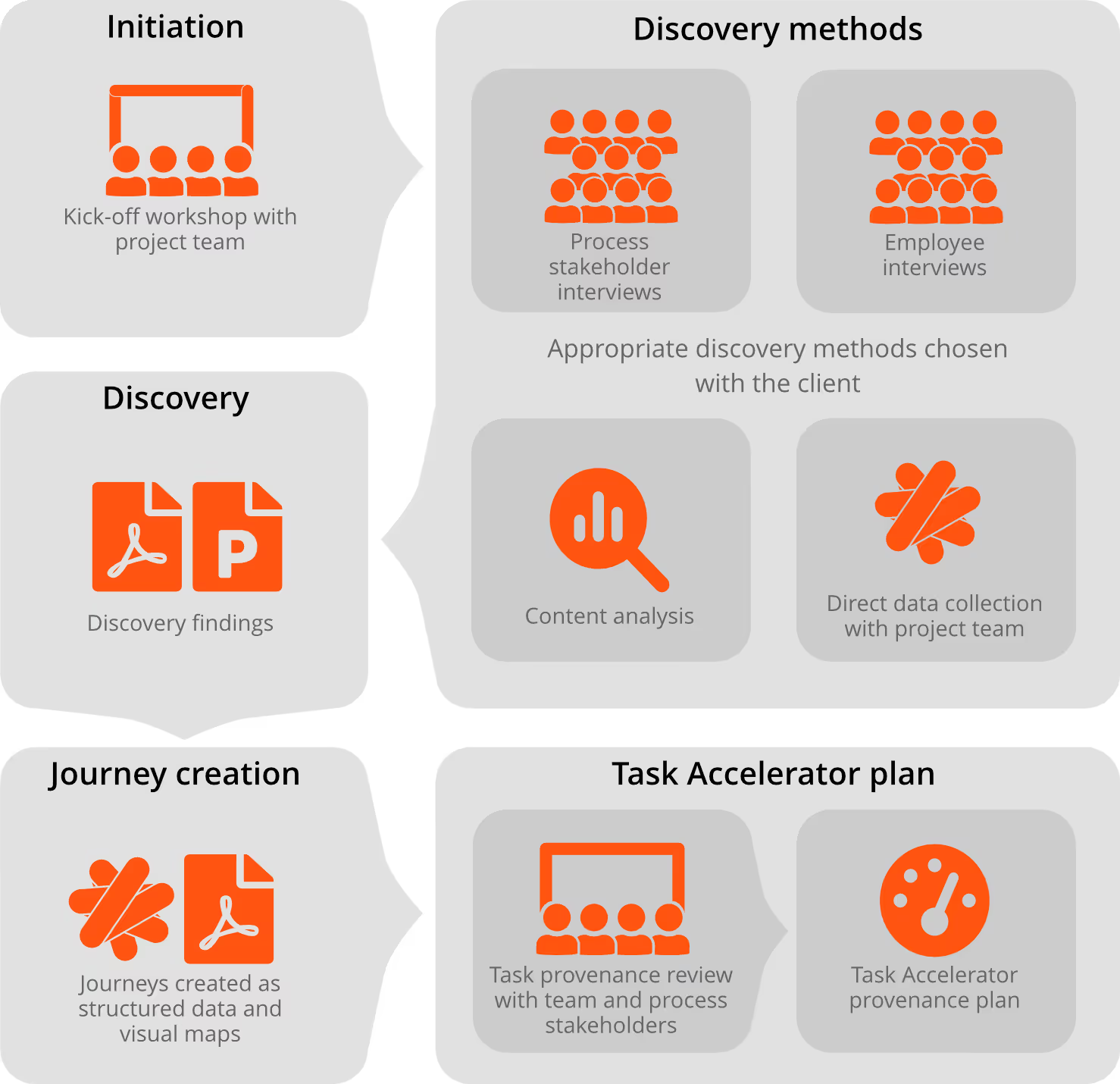
Diagram outlining Spark’s Task Accelerator consulting process across six stages:
	1.	Initiation – Kick-off workshop with the project team.
	2.	Discovery methods – Client and Spark select appropriate methods from: stakeholder interviews, employee interviews, content analysis and direct data collection.
	3.	Discovery – Findings documented in structured formats (e.g. PDFs and presentations).
	4.	Journey creation – Process journeys are mapped visually using structured data.
	5.	Task Accelerator plan – Spark and stakeholders review blockers and inefficiencies.
	6.	Final output – A Task Accelerator improvement plan is delivered.

Improving the employee digital journey

Improving the employee digital journey starts with understanding how work actually happens — not how it's assumed to happen. Most organisations have never systematically mapped how their people complete tasks across the tools, content, and processes that make up the digital workplace. Without that foundation, improvements are reactive and piecemeal.

Task Trajectory provides that foundation. Through structured interviews, detailed journey charting, and content analysis, we give you an evidence-based picture of where journeys break down, where content is ambiguous or conflicting, and where AI tools will produce unreliable answers. The result is a prioritised plan to improve the employee digital journey across the areas that matter most.

Who provides specialist user journey mapping for digital workplace environments?
Spark Trajectory's Task Trajectory is a specialist methodology designed specifically for intranets and digital workplace environments. Unlike generic UX journey mapping, it combines employee experience research with AI misinformation risk assessment and provenance planning — making it relevant not just for usability improvements but for organisations preparing for Copilot, AI search, and other enterprise AI tools.

Get sparks in your inbox

We like to share our experience and models with practical examples and ideas that you can use in your day to day work.  Get our low-volume, high-quality newsletter. Interesting, useful and engaging. We promise.

We’ll only use your email for this newsletter. No spam, no sharing. We use MailerLite, and your data is stored securely in the EU. You can find everything openly in our privacy policy and you can unsubscribe at any time.

When we can help

User journey mapping is ideal as a technique at pretty much any time.

Let's fix your intranet

Talk to industry experts Steve or Chris for a no-nonsense take on your digital workplace challenges. No outsourcing. No juniors.

Book a chat. Never the hard sell.

book a 30m meeting

Recent Task Trajectory articles

The AI Epiphanies, Part Three: Mapping and managing the epistemic landscape

Mapping employee task journeys will manage epistemic risk: we're turning employee journey mapping into an essential risk management technique for the AI era.

February 10, 2026
LinkedIn
Chris Tubb

The AI Epiphanies, Part Two: How Provenance restores order to a fractured digital workplace

Provenance: a coordination layer ensuring authoritative, explainable AI-driven workplace information—aligning content, agents and governance to reduce misinformation risk.

February 3, 2026
LinkedIn
Chris Tubb

The AI Epiphanies, Part One: Seeing the Hidden Landscape Beneath Enterprise AI

Enterprise AI needs "Provenance": a discipline to make content AI‑legible, prevent misinformation, and govern publishing boundaries for trustworthy synthesis.

January 27, 2026
LinkedIn
Chris Tubb

The AI Heresies, Part Three: The Organisational Domain in the Digital Workplace

Why Microsoft 365 Copilot risks confidently inventing organisational answers — and practical steps to protect employees through tighter governance, targeted access, and better content design.

September 2, 2025
LinkedIn
Chris Tubb

Person, Prompt, Path, Product, Process, Problem: A top-down guide to employee user journeys

This post outlines our 'Six Ps' framework for improving digital workplace management: Person, Prompt, Path, Product, Process, and Problem. Creating a smoother digital employee experience.

June 23, 2024
LinkedIn
Chris Tubb

Climbing Mount Findable to Peak Understanding

To complete their tasks you colleagues need to be able to find stuff and then after that they need to actually understand what they find there. We take a (figurative) spiritual journey up the mountain.

February 16, 2024
LinkedIn
Chris Tubb

Actively managing employee applications with user journeys

Providing effective access to key employee services is more than putting a few tiles up on the intranet. Learn how to utilise user journeys and user stories so you understand what employees need.

August 2, 2021
LinkedIn
Chris Tubb