
What Is a Communications Channel Matrix?
Communication matrix design is very simple. It's just a map of which channels go to which groups of employees, indicating the best usage for each. From the point of view of the employee, they have multiple sources of communications coming at them every day. There is broadcast email and the intranet. There is Viva Engage and Virtual Town halls. Maybe you've got a specific frontline app or digital signage. If you are a large organisation each person will be exposed to communications from many perspectives:
- Global
- Geography — region, country, city, office
- Organisational levels — division, group, department, team
- Role, hierarchy or tenure — managers, new starters, trainees
- Project or business process
- Community — affinity groups, professional networks, communities of interest, sports and social groups
All of this messaging comes at them every day. The bigger your organisation the more complexity there will be. But formal communications is not the only internal communications they get. For each of the geographical, organisational, role, project or process or community areas, looking top-down, there will exist "communications dark matter". This dark matter is not created by internal communicators but arrives in similar ways, particularly email, Teams and Viva Engage (if you use it). Some of this will be nice to know and some will be essential or actionable (such as HR message or something from facilities about your office). Some of it will be of no value.
If you have an international footprint, you may have languages to consider too. What gets translated, what doesn't, what are the working languages? The importance of geography is sometimes underplayed by communicators. Employee processes tend to be delivered along national lines as that is how payroll, procurement, recruitment, expenses is delivered as well as things based on local legislation.
Why Governance Matters for Internal Communication Channels?
A failure to bring control and sense will add to the chaos. Each of the different sorts of channels has meaning to communicators (these are their tools of the job after all), but for employees they can very quickly get lost and begin to glaze over and start to ignore the whole environment.
If you don't know what's out there, you can't describe the communications environment. If you can't describe it, you can't manage it.
Governance is about clarity – nice clean lines that everyone is aware of. If there is a problem, different groups can talk it out and resolve it. But without clarity? People then improvise, do what they think is best, sulk, misbehave or go maverick. A channel matrix allows you to define the space and record useful information against each level as well as guide people's practices. It answers the question, "What's the best way to get this message out, to this audience, for the best impact?"
How to Map Your Internal Comms Channels
- Map the organisation: What does the playing field look like? Collect and organise the things that describe the different areas of interest such as organisation, brands and geography.
- Map the likely audiences: If you can, get hold of some employee data. You need to know how many people that are in each of those organisational units and geographies. It's likely that some far flung branch offices are very small. This is also where you can try and find things about languages too.
- Map the tech: Look at the existing channels that you're aware of. What digital tools do they use to deliver them?
— Intranet news: SharePoint or something a little more toothy like Interact or Unily
— Broadcast email: Something like Poppolo or JungleMail, or perhaps even just Outlook and email lists.
— Social platforms: Things like Viva Engage, even LinkedIn.
— Frontline apps: Such as Staffbase or Blink
— Digital signage: Such as AppSpace or ScreenCloud
— Newsletters: Anything exotic
— Town halls: Specific webinar style tech, or plain old Teams or Zoom. - Audit the known: Look at the channels you know about and look at samples of them.
- Interview users: This is critical – you have to speak with a representative sample of users. Discover the sources of news and information that they find the most useful for them and any frustrations that they have. They might tell you of the impact of the dark matter communications that also lead to the loading of their communications "workload" or of channels you haven't even heard of. They will tell of their favourite methods for keeping up to date and the personal tactics they have to employ to find information that is essential for them.
- Work with comms leads outside of the corporate centre. Get their input about how they put together their channel mix and get their help to understand additional channels that they create and maintain.
Putting it together
Now you've got the basic data, you can start to put some shape to it.
The communicators story
At Spark Trajectory we like to look at thing in user stories. It cuts through the crap. What do people need to achieve and what is their daily task and in what digital tool can they complete that tasks? We wouldn't pretend to know more than you internal communicators about your message, but broadly when it comes to channels we are talking about large audience and you need to tell them something or get them to act, or both.
Everything stems from those two key needs. The communicator is then faced with matching those needs to the different channels that are available like paints on a palette.
The key questions
- Is it time bound?
Does the message need to find someone within a specific timeframe or ASAP? - Is it high stakes?
Is there an impact if the message doesn't land? - Is it actionable?
Does the employee need to do something in response to this message? - Is it strategic?
Is it the big picture stuff that shows people their part in the whole? - Is it engaging?
Is it the stuff that makes you feel warm, proud or recognised? - Is it for discussion?
Is it a topic that would gain from people talking about it, or needs the ability to ask questions to understand or process ambiguity?
Not everything is a critical communication
When speaking to regular employees you will find that they really want to get a handle on what is essential. They get busy and they need to know what channels they can cling to like a life raft:
- When they get too busy
- When they've been out of the office and need to catch up
- When they need to know that they haven't missed anything really important
As part of your matrix, you need to decide what is critical for your organisation, and where that critical stuff goes. It is up to you as part of the process, but for is this our formula for critical:
Time bound + High stakes + Actionable = Critical
Criticality needs to be limited and you need to get across the idea that critical is not the same as important. Loads of things are important but critical needs to be reserved for something that has to happen now, for something that will have a big impact if it doesn't happen, and needs people to change their behaviour or routine.
- A notice about a weather event and the office being closed is critical
- A message about the organisation being acquired is critical
- A communication detailing that an operational system is going to be replaced on a certain date is critical.
Any crisis communication fits in this category.
You need to work out what channels are used to send critical communication.
Push or pull
This classification is straight out functionality of the digital channel.
- Push channels arrive in front of people's noses
Emails, messages and notifications. Ping! But also digital signage. - Pull channels require people to go somewhere
Intranet, Viva Engage, Frontline apps, virtual town halls. It requires someone's engagement and habit to engage.
All or some
The concept of "All employees" for virtually all organisations is staunchly defended territory. Targeting a message to everyone depends very much on the push and pull. Putting something on the intranet for everyone to see is much less of a demand that sending everyone an email. In reality, in the realm of push messaging in large organisations there is usually some demand to put a local spin on it to make it more relevant to the target group.
Frequency
How often do each of these channels hit their audiences? Setting and recording an expectation is important in understanding whether the channels are healthy.
- Multiple times per day
Updates to Viva Engage for example - Daily
Such as intranet news - Weekly
For instance a summary digest - Monthly
For a regular newsletter - Quarterly or biannually
Town halls - Annually
A company all-hands or a results day extravaganza
And there is also the tricky one:
- As required
We firmly believe that "As required" has the inevitable translation of "Whenever I bloody want." It therefore is best reserved for critical communications if used at all.
Documenting and explaining
OK, now let's put it black and white.
The matrix
The matrix itself is the core of it. A spreadsheet will do for now, but a database is better (we use a tool called Fibery, you could use Airtable and at a push with a lot of shouting and screaming, SharePoint).
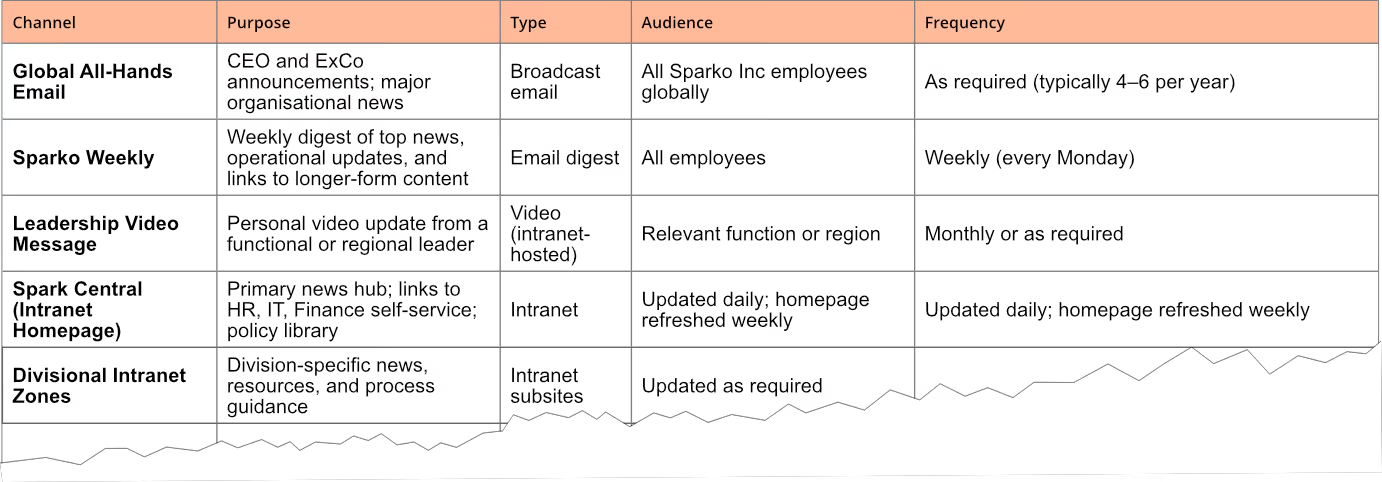
You can download a sample spreadsheet to save you about three minutes in Excel: Sparko_channel_matrix 11kb
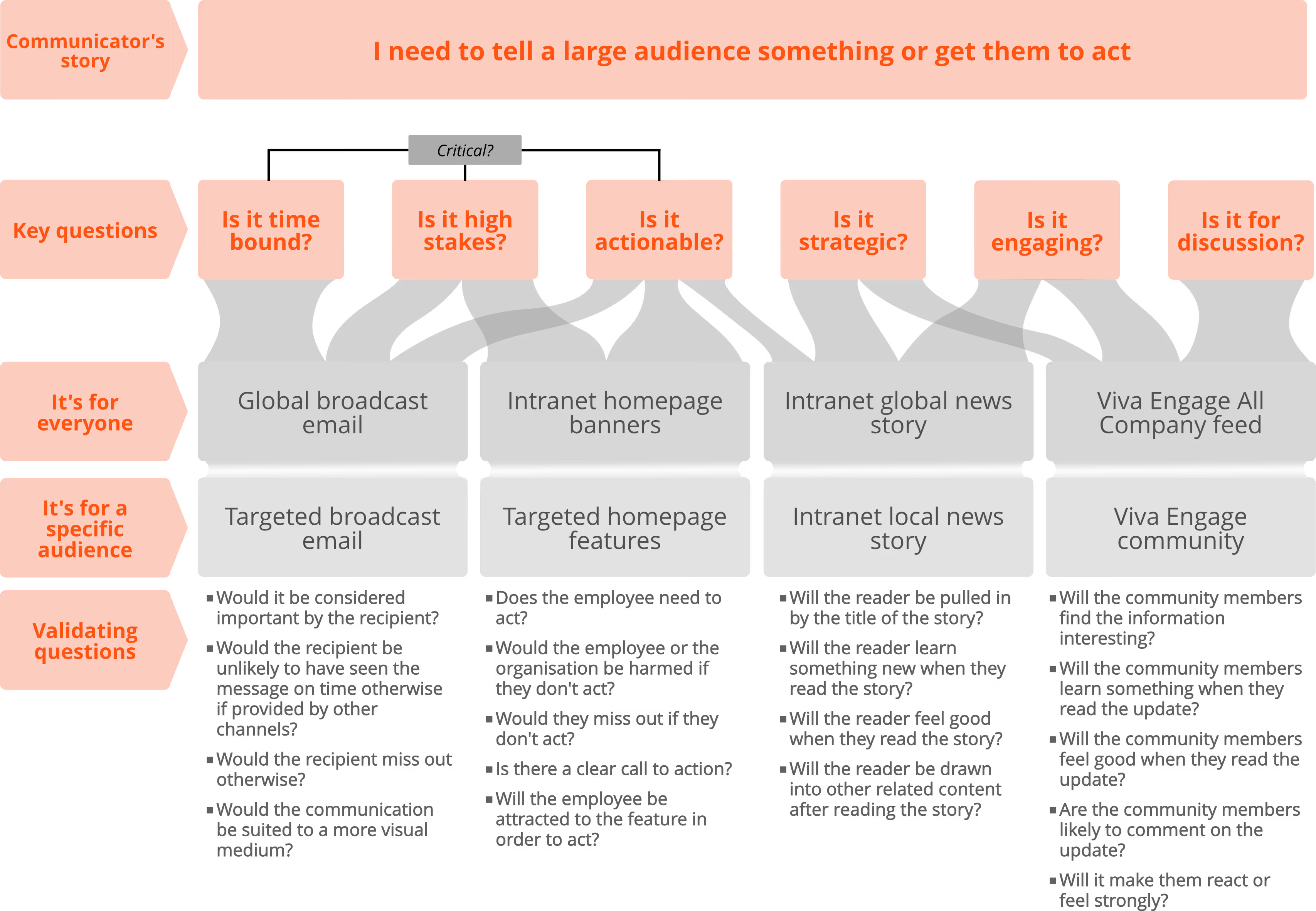
The flowchart, the decision tree, the allocation framework, the rule of thumb
The matrix is what we call in governance terms a "Register". Like stamp collecting and cricket statistics its very much for the fans. Something that you will use to be able to point at and tap the sign. This is what we've got and what we expect. But it doesn't really help other communicators throughout the organisation make choices.
For that you need form of decision tree, flowchart or ready-reckoner that helps communicators help make good choices and can work for non-communicators to appreciate the landscape.
We've seen these get very elaborate, like a choose your own adventure story with a bunch of hard-coded criteria in. This can work, but they can confuse people and they can get very brittle. As soon as something unexpected happens the whole regime falls apart.
We whipped this one up after an engagement. More of a map to guide people's way and think about audiences and impact first and an appropriate digital platform second. No hard edges, just good advice.

Written by Chris Tubb
Get sparks in your inbox
We like to share our experience and models with practical examples and ideas that you can use in your day to day work. Get our low-volume, high-quality newsletter. Interesting, useful and engaging. We promise.
We’ll only use your email for this newsletter. No spam, no sharing. We use MailerLite, and your data is stored securely in the EU. You can find everything openly in our privacy policy and you can unsubscribe at any time.
"If you don't know what's out there, you can't describe the communications environment. If you can't describe it, you can't manage it."